
Monday, 22 March 2010
New Irish Children's Publishers


Sunday, 21 March 2010
Flash Fiction
Click on the the title of this post to go to writer's Vanessa Gebbie's blog to read how this year's judge of the Sean O' Faolain short story competition loves flash fiction.
Food for thought and a reminder that when you enter a competition you don't have to write up to the maximum word limit. Be dictated by the idea - some stories need room to breath, others are better told in tight prose that forces the reader to do most of the work.
Food for thought and a reminder that when you enter a competition you don't have to write up to the maximum word limit. Be dictated by the idea - some stories need room to breath, others are better told in tight prose that forces the reader to do most of the work.
What is flash fiction?
No standard word count - here is how the Bridport Writing Competition describes it. http://www.bridportprize.org.uk/flashfiction.htm
This year for the first time there is a special category for Flash Fiction
No standard word count - here is how the Bridport Writing Competition describes it. http://www.bridportprize.org.uk/flashfiction.htm
This year for the first time there is a special category for Flash Fiction
Flash Fiction is fiction of extreme brevity. The number of words can vary widely - for our competition it will be a maximum of 250. Other names for flash fiction include sudden fiction, microfiction, micro-story, postcard fiction, prosetry and short short story. Flash fiction work contains the classic story elements: protagonist, conflict, obstacles or complications and resolution. However unlike the case with a traditional short story, the word length often forces some of these elements to remain unwritten: hinted at or implied in the written storyline.
(Digression...Sean O' Faolain was a major figure in 20th century Irish literature. He wrote 80+ short stories that reveal the concerns of ordinary people and in themselves chart a changing social and political landscape. Well worth reading if you are grabbed by fiction where character dominates...
Digression number two...Whelan is an anglicised version of O' Faolain. (Phelan is another) Sean O' Faolain was born John Whelan in Cork around 1900 and his mother was Bridget Whelan...just thought I'd mention it)
Digression number two...Whelan is an anglicised version of O' Faolain. (Phelan is another) Sean O' Faolain was born John Whelan in Cork around 1900 and his mother was Bridget Whelan...just thought I'd mention it)
One night only...and it's tonight in Brighton
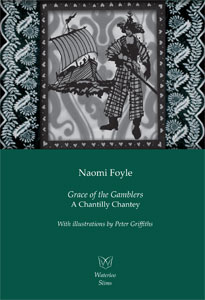
Grace of the Gamblers is a ballad pamphlet performance poet Naomi has developed as part of her PhD thesis. It tells the story of Grace O'Malley, a pirate queen who lived off the Mayo coast at the time of Queen Elizabeth the First. The two queens met and are supposed to have liked each other. Or at least Elizabeth saw the promotional opportunities of being associated with a woman who was a legend in her own life time.
Here is a taster....
O come to the convent, young ladies of Mayo,
We'll arm you with needles and thread.
Outside in the trenches, a summer of spuds
Is rotting away like the dead...
in their beds...
Is rotting away like the dead
Wednesday, 17 March 2010
And the winner is....LOVE STORY 2010
Had a wonderful day yesterday as a guest of the Romantic Novelists Association. This is their 50th anniversary and they organised a splendid lunch and awards ceremony. I was there as judge of the Love Story of 2010.
Our task as judges was to go live six new lives. We hung out in a millionaire’s pad, the editorial department of a top magazine, a cake shop, an animal sanctuary, a regency theatre and we also went to the races. We met intelligent heroines, bright eyed and confident; we met intelligent heroines, bright eyed and absolutely convinced no man would give them a second glance. And the heroes? They weren’t all tall, dark and handsome (although some certainly were) but they did have one characteristic in common: they were all men you remembered after the story ended. ALWAYS THE BRIDESMAID is a gentle love story. The heroine is a believable mix of contradictions: brave and shy, positive and indecisive, sexy and full of self doubt. And the cakes she bakes in her one woman business are as tempting as the handsome hero who captures her heart. Author: Nina Harrington In contrast, CLAIMED FOR THE ITALIAN’S REVENGE is a story brimming with passion rather than love. Marco sweeps the heroine off her feet. He thinks it’s lust; he thinks it’s payback for something that happened in the past, but the reality is he has found the only woman he could ever love. Author: Natalie Rivers A host of characters from a dyslexic wedding planner, to a teenager in a coma and a fifty something ex wife come together in THE WEDDING PARTY. This is an intriguing tale of love and loss that has many layers, all of them absorbing and all of them revolving around a second chance romance. Author: Sophie King ANIMAL INSTINCTS is also a contemporary story. An animal sanctuary is on the brink of bankruptcy and a dashing property magnet shows a keen interest. But is it love or is it land that sets his pulse racing? A foul-mouthed parrot adds a running commentary to the on/off romance. Author Nell Dixon The intelligent, compelling hero of THE NOTORIOUS MR HURST -- is matched by an equally intelligent, compelling heroine. In this Regency love story it is society and class prejudice that threatens to keep them apart and keeps the reader turning the page. Author Louise Allen FAIR DECEPTION is also set in the Regency period but this time we go inside the world of touring theatre and meet a real villain. He’s not the kind you boo off the stage. He’s the kind you fear. The air of violence that surrounds everything the would-be seducer does brings real tension to a touching love story. Author: Jan Jones And we had to choose the winner. It was a tough decision but the panel not only fell in love with the hero and heroine but also with the cast of characters: especially the celebrity-with-a-heart (and-a-drink-problem) and a parrot that just will not keep its beak shut. --- the Love Story of 2010 is Nell Dixon for ANIMAL INSTINCT
Someone once said that if you don’t read you’re stuck with just one life: but if you do read you can live a thousand lives.
.
Happy St Patrick's Day
I'll be in The Foundry tonight listening to The Celtic Ti-grrs. I saw them at Fontwell Racecourse the year they supported The Saw Doctors. I love this - even though I count myself as second generation Kerry.
Sunday, 14 March 2010
Inspiration from Google

Here's how to find the spark that ignites a new work of fiction on Google. Or more precisely Google searches.
Click on the title of this post to go to writer Tim Challies' blog where he reconstructs a sad story from one surfer's search. If you're inspired, you don't need access to confidential information from AOL; not when you can imagine it...
Saturday, 13 March 2010
Finding Inspiration
In class this morning I talked about my first boss. Jack Walsh was a news editor who was rumoured to have set type (the old hot metal stuff) before he was old enough to go to school. I was 16 when he told me that any true newspaper man - this was the 70s - only had to go to the bottom of the road to get a story. It was out there: we shouldn't wait for it to land on our desk.
Fiction writers don't even have to open the front door.
Today's exercise was about finding inspiration from a newspaper. Each group had to select three or four items from Friday's Evening Standard. Then individually each student wove these elements into a coherent story and it is was wonderful to hear the magic that came out: small details from adverts were the trigger for well rounded, fully formed characters, a one paragraph business report was part of a surprising twist, a feature article provided the nuts and bolts of a who-dun-it.
Fiction writers don't even have to open the front door.
Today's exercise was about finding inspiration from a newspaper. Each group had to select three or four items from Friday's Evening Standard. Then individually each student wove these elements into a coherent story and it is was wonderful to hear the magic that came out: small details from adverts were the trigger for well rounded, fully formed characters, a one paragraph business report was part of a surprising twist, a feature article provided the nuts and bolts of a who-dun-it.
Saturday, 6 March 2010
March 5th 1667 Let the world go hang
But, Lord! to see to what a poor content any acquaintance among these people, or the people of the world, as they now-adays go, is worth; for my part I and my wife will keep to one another and let the world go hang, for there is nothing but falseness in it. So home to supper and hear my wife and girle sing a little, and then to bed with much content of mind.
If you want more from Mr Pepys you will find his blog by scrolling down the right hand column
If you want more from Mr Pepys you will find his blog by scrolling down the right hand column
Friday, 5 March 2010
Judging a book by its...(2)


Same book...different country, different cover...and presumably different expectations provoked...
US version on top.
Judging a book by its...(1)


Join the debate and find other recent UK/US book covers by clicking the title of this post
Wednesday, 3 March 2010
Dream Bookcase

A new way of funding the arts...
Click on the title of this post to go to Kickstart, an American website that encourages visitors to contribute toward the funding of an arts project in a Dragons' Den kind of way.
Every project has a funding goal (any dollar amount) and a time limit (from 1 - 90 days) set by the project creator. When the deadline is reached, there are either of two results:
1. Funding Successful: If a project has met or surpassed its funding goal, all backers' credit cards are instantly charged and funds go directly to the project creator. Project creators are then responsible for completing the project and delivering rewards as promised.
2. Funding Unsuccessful: If a project has NOT met its funding goal, all pledges are canceled. That's it.
Pledges can come from anywhere in the world but projects have to be US based
1. Funding Successful: If a project has met or surpassed its funding goal, all backers' credit cards are instantly charged and funds go directly to the project creator. Project creators are then responsible for completing the project and delivering rewards as promised.
2. Funding Unsuccessful: If a project has NOT met its funding goal, all pledges are canceled. That's it.
Pledges can come from anywhere in the world but projects have to be US based
Tuesday, 2 March 2010
Making History

I'm delighted to be part of a new two year project that will record the history of a forgotten part of Brighton, thanks to a £49,700 grant by the Heritage Lottery Fund (HLF). Tarner, the area around Carlton Hill, is in the heart of the city. Everyone knows it – if only because of the landmark American Express Building – and because it is a short, steep, walk from the Pavilion. Somehow though it has always been on the margins, but it is rich in working class history. Part of Brighton Rock was set in these streets and Graham Greene must have known the area well on his visits to Brighton.
I will be Writer in Residence at Brighton Unemployed Centre - an inspirational community place that is run by the unemployed for the unemployed. It is already a hub of creative education running a range of exciting free and low cost educational classes from computer skills and belly dancing to Japanese for beginners. The Centre will train volunteers to gather the stories of ‘old Tarner’ by creating oral history recordings, photographs and artwork evoking the past. But we will also focus on what is happening in Tarner right now - a book and an exhibition will come out of the project and lots of other creative things...
Australia: a nation of readers
A major survey undertaken for the Australia Council for the Arts reveals that 85% of the people questioned described themselves as avid poetry and literature readers. I am going to search for similar surveys of the UK and US but that figure would surely be hard to beat...
Monday, 1 March 2010
Subscribe to:
Posts (Atom)